Lenzic
Optical Store Accounting Software: Cash Close, Insurance and Stock
What optical store accounting software needs: cash drawer and end-of-day close, insurance and patient balances, frame and lens inventory, supplier debts and real profit, and how Lenzic covers each.
Short answer: Accounting software for an optical store has to see more than invoices and stock. It should keep the insurance share, deposits and patient balances apart, know what each frame and lens actually cost you, record supplier purchases and debts, and close the cash drawer at the end of every day. Lenzic, complete and specialist software for optometry clinics and eyewear galleries, keeps all of this next to the patient's prescription in one cloud platform. Statutory accounts and tax filings still belong with your accountant; Lenzic hands them clean daily numbers.
If you run an optical store or an eyewear gallery, this scene is probably familiar. At closing time, the cash drawer doesn't match the invoice total. Some money came in by card and some in cash, one patient's insurance share hasn't arrived yet, and another patient paid a deposit while their glasses are still at the lab. None of this is a mistake. The trouble starts when all of it lands in a single column called "sales."
Below we look at why optical retail accounting is different and how Lenzic handles each pressure point.
Why optical store accounting is different
In most shops, one item has one code and one price. In an optical store, one "sale" is usually several pieces: a frame from the showcase, two lenses that may come from stock or be ordered from the lab, and sometimes an exam fee. Behind all of it sits a prescription with SPH, CYL, axis and ADD. Misread it, and the cost of a remade lens comes straight out of that sale's margin.
Timing matters too. Payment for a pair of glasses rarely arrives in one go: a deposit today, the insurance share later, the balance at pickup. That gives you two financial questions that should never be mixed. The first is profit: sales and exam revenue minus the cost of goods and expenses. The second is cash: how much money actually came in and went out today. Accountants call these the accrual view and the cash view. A store can be profitable on paper and still be short of cash.
General accounting software understands both views but knows nothing about prescriptions, frames and lenses. Practice software knows the prescription but not the gallery's stock or cash drawer. The gap sits right between the two.
What is Lenzic?
Lenzic is complete and specialist software for optometry clinics and eyewear galleries, not an eyewear store. It brings reception and appointments, exams and prescriptions, sales, frame and lens inventory, the cash drawer and finance reports into one cloud platform. When the seller opens an invoice, that patient's prescription is already on screen. We cover the full path in from prescription to gallery invoice.
Five money problems in optical retail, and how Lenzic solves them
1. Cash, insurance and patient balances get mixed up
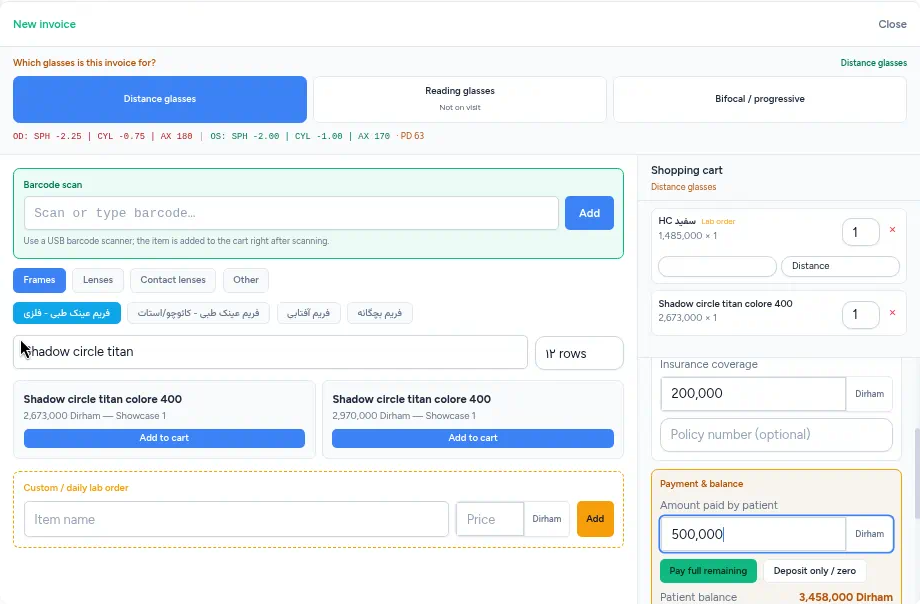
When the insurance share and deposits sit in one column, nobody knows who owes what. In Lenzic, the gallery invoice shows insurance coverage with a policy number, the amount paid by the patient and the remaining patient balance separately. The seller can take a deposit only or settle the full balance, and the patient ledger and insurance claims are tracked separately under Finance. The invoice also records which pair it's for: distance, reading or bifocal/progressive.
2. The real cost of frames and lenses
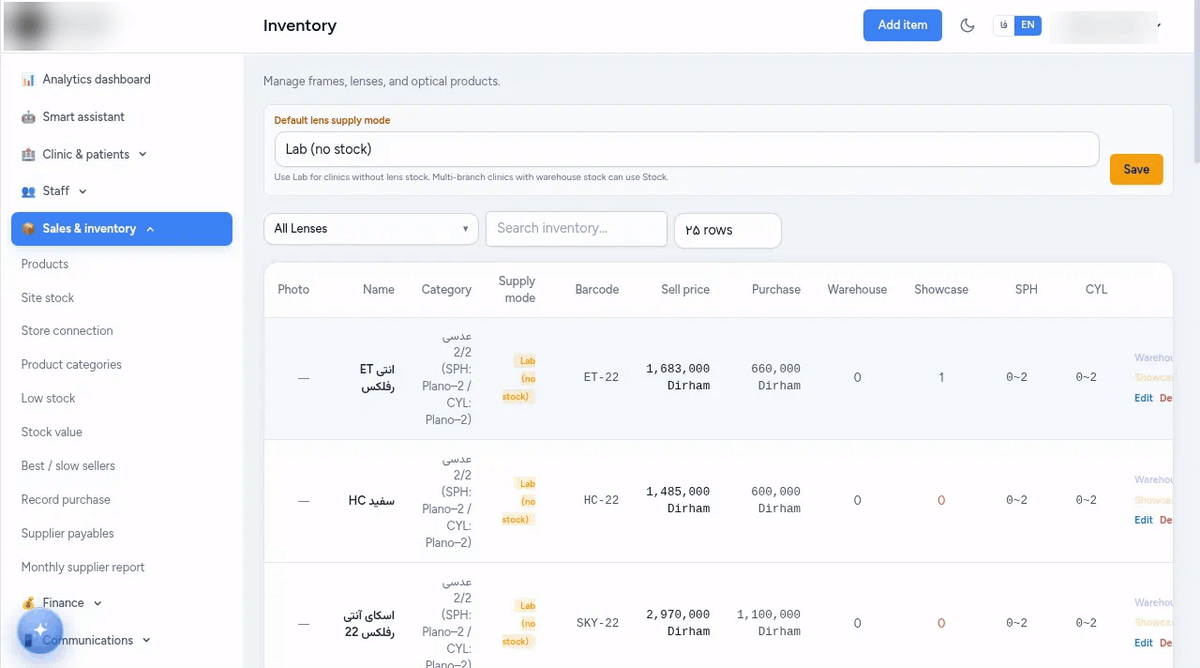
Invoice totals don't tell you your profit; you need to know what the goods cost you. Lenzic shows invoices, showcase, purchasing and cost in one view, and its profit and loss report sets the optical goods margin against the cost of goods sold. The frame and lens inventory keeps separate warehouse and showcase quantities for every item, each item carries its sale price and purchase price, and lenses carry their SPH and CYL. At the counter, items go into the cart by barcode scan or search, with showcase stock shown right there. Once the invoice is issued, frame and lens stock is reduced automatically, so a sale and its stock movement are one event, not two entries, and nobody has to adjust stock by hand. Lenses you don't keep in stock go on the same invoice as a custom or daily lab order.
3. Supplier purchases and debts
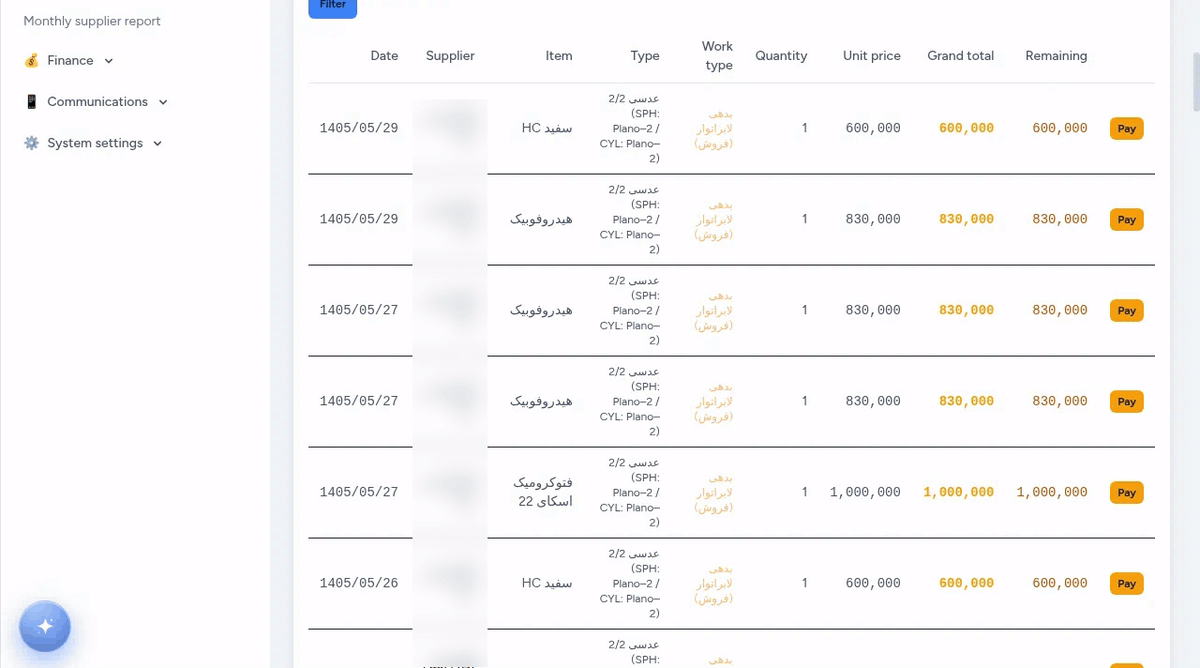
If purchases live in a separate notebook, both stock and cost turn into guesses. In Lenzic, purchasing and the supplier list are part of the same system. Each purchase is recorded with the supplier, item, quantity, unit price and the amount still owed, and there is a separate supplier debts view and a monthly supplier report. With every purchase, the item's weighted-average cost is updated automatically. In plain terms, if you bought one batch of lenses at one price and the next batch at a higher price, each lens is costed at the weighted average of the two, not at whichever price someone remembers. That keeps cost of goods tied to what you actually paid.
4. The cash drawer and the end-of-day close
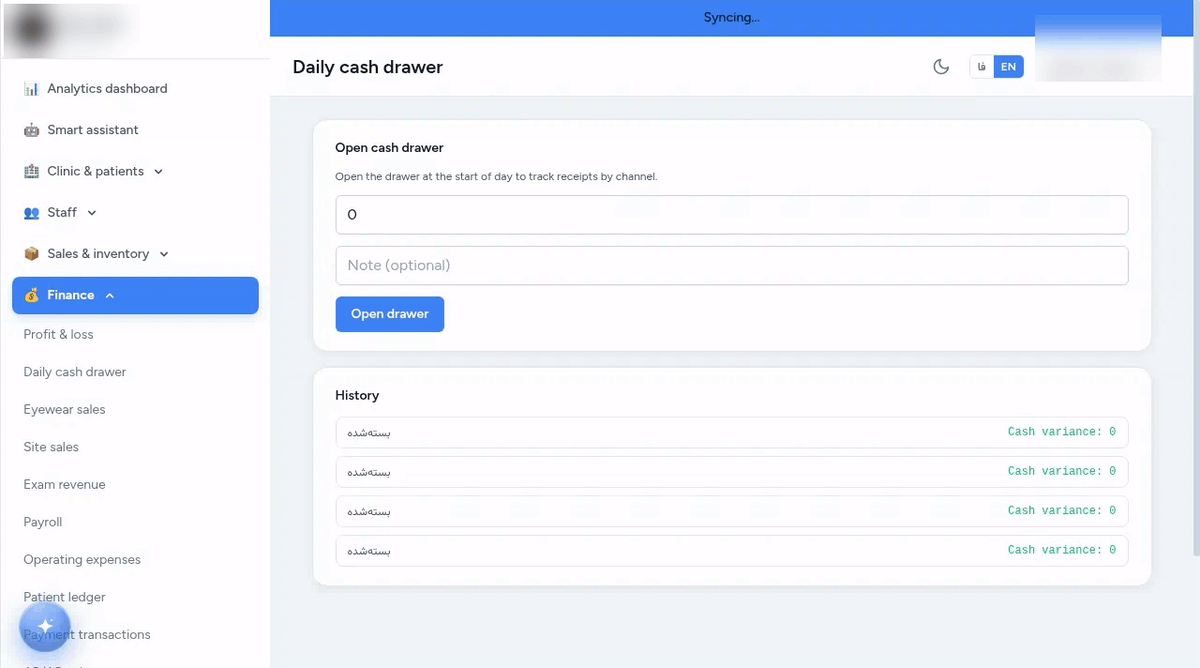
Cash discrepancies usually come from incomplete entries, not real shortages. In Lenzic, the daily cash drawer opens at the start of the day with a starting amount, and the end-of-day cash close closes out that day's drawer. In the drawer history, each closed session shows its own cash variance, so a day that came up short or over stands out at a glance.
5. Expenses, payroll and real profit
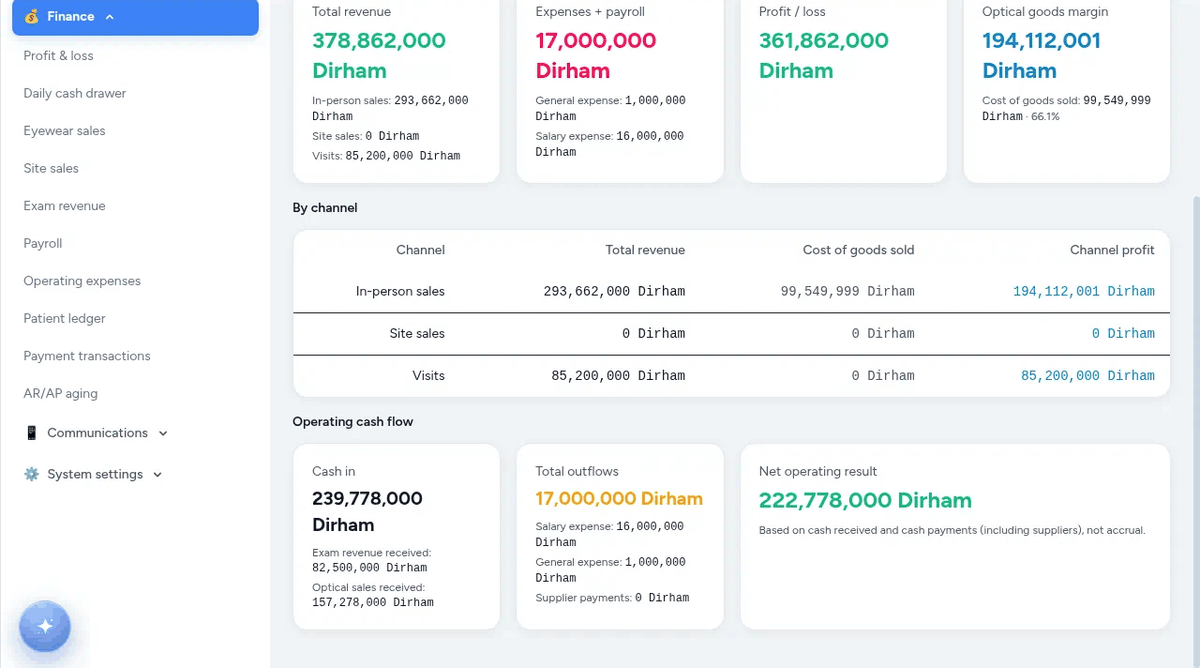
Lenzic builds profit and loss from one clear formula: (in-person sales + site sales + exam revenue) − (general expenses + payroll). Further down the same page, a channel breakdown shows revenue, cost of goods sold and profit for each channel (in-person sales, site sales and visits), so you can see where the margin really comes from. A separate operating cash flow view counts only money received and paid out, supplier payments included, on a cash basis rather than accrual. Reports filter by date range and payment method, and sales can be exported as a CSV file for your accountant.
Checklist: what optical store accounting software needs
| What the store needs | Why it matters | How Lenzic covers it |
|---|---|---|
| Invoices tied to the Rx | Sellers don't retype powers | Gallery invoice with the same patient's Rx, for distance, reading or bifocal/progressive |
| Insurance, deposits and balances kept apart | You know who owes what | Insurance share, patient payment and balance on the invoice, plus the patient ledger and insurance claims |
| Frame and lens inventory | Stock isn't a guess | Frame and lens inventory with warehouse and showcase quantities, barcode scan and automatic stock reduction after invoicing |
| Cost of goods | Real profit, not invoice totals | Purchase price per item, weighted-average cost on every purchase, optical goods margin and profit per channel |
| Purchasing and suppliers | Purchases and stock stay in one picture | Purchase entry, supplier debts and monthly supplier report |
| Daily cash drawer | Discrepancies surface early | Daily cash drawer, end-of-day cash close and cash variance per closed session |
| Expenses and payroll | Net profit is visible | General expenses and payroll inside profit and loss, plus operating cash flow |
| Reports for the accountant | Formal books close on accurate numbers | Date and payment-method filters and sales CSV export |
AI in Lenzic: from an accurate Rx to management decisions
Some of a gallery's hidden losses start with the prescription, because converting powers by hand often ends in remakes. Lenzic's smart tools:
- AI lens power conversion: applies optometry logic to convert prescription powers for vertex distance and lens type, reducing manual errors between clinic and lab.
- Smart lens filter.
- Smart doctor panel: clinical cues such as amblyopia alerts under age 11 and ADD suggestions over 40, alongside fast exam capture and prescription printing.
The optics behind the conversion are explained in lens power conversion and vertex distance.
On the management side, Lenzic also has a built-in AI assistant, the smart management assistant, which suggests campaigns and marketing ideas tailored to your gallery. Its suggestions are a starting point; the decision to run any campaign stays with the manager.
Where formal accounting and tax stay
Statutory books and tax filings usually stay with your accountant. Lenzic's job is to hand that layer clean, trustworthy daily numbers, not to replace it. If you need a direct connection to a general accounting package or a tax system, ask about it in the demo.
What to test in a demo
Simulate one real day: open the drawer, issue an invoice with a frame, a lens, an insurance share and a deposit, check that stock went down, record a supplier purchase, close the drawer and then open profit and loss. If all of that runs without a spreadsheet or retyping, you've found the right tool. For the rest of the criteria, keep the optical clinic software checklist and the optical clinic software buyer's guide at hand, and see optical frame inventory management for the stock side.
FAQs about optical store accounting software
What features should optical store accounting software have?
Invoices tied to the prescription, separate insurance share, deposit and patient balance, frame and lens inventory, cost of goods, supplier purchases and debts, a daily cash drawer with an end-of-day close, and a profit and loss report. Lenzic keeps all of these next to the patient record in one cloud platform.
Does Lenzic replace my accountant or general accounting software?
No. Lenzic runs the day-to-day books of the gallery and clinic: invoices, insurance, inventory, purchasing, the cash drawer and profit. Statutory books and tax usually stay with your accountant, and Lenzic hands over clean numbers through its reports and sales CSV export.
How does Lenzic handle insurance shares and patient balances?
On the gallery invoice, the insurance share is recorded with a policy number, alongside the amount the patient paid and the remaining balance. The patient ledger and insurance claims are then tracked separately under Finance.
How do I see the real profit of my eyewear gallery in Lenzic?
The profit and loss report adds in-person sales, online site sales and exam revenue, subtracts general expenses and payroll, and shows the optical goods margin against the cost of goods sold. A channel breakdown shows profit per sales channel, and operating cash flow shows money received and paid out separately.
How does AI in Lenzic help an eyewear gallery?
AI lens power conversion and the smart lens filter reduce manual prescription errors between clinic and lab, and the smart doctor panel adds cues such as ADD suggestions over 40. The smart management assistant suggests campaigns and marketing ideas tailored to your gallery.
Closing
Optical store accounting works when money, stock and the prescription stay connected. In Lenzic, the invoice is tied to the Rx, frame and lens inventory and cost of goods sit next to every sale, and the daily cash drawer and profit and loss report read the same numbers.
To see this flow with your own scenario, request a free demo and the Lenzic team will get in touch.